The Types of Psychology of Money and Scarcity Mindset: Complete Classification and Characteristics
The 4 "money scripts" per Klontz and Britt: avoidance, worship, status, and vigilance — and how each one formed in your childhood.
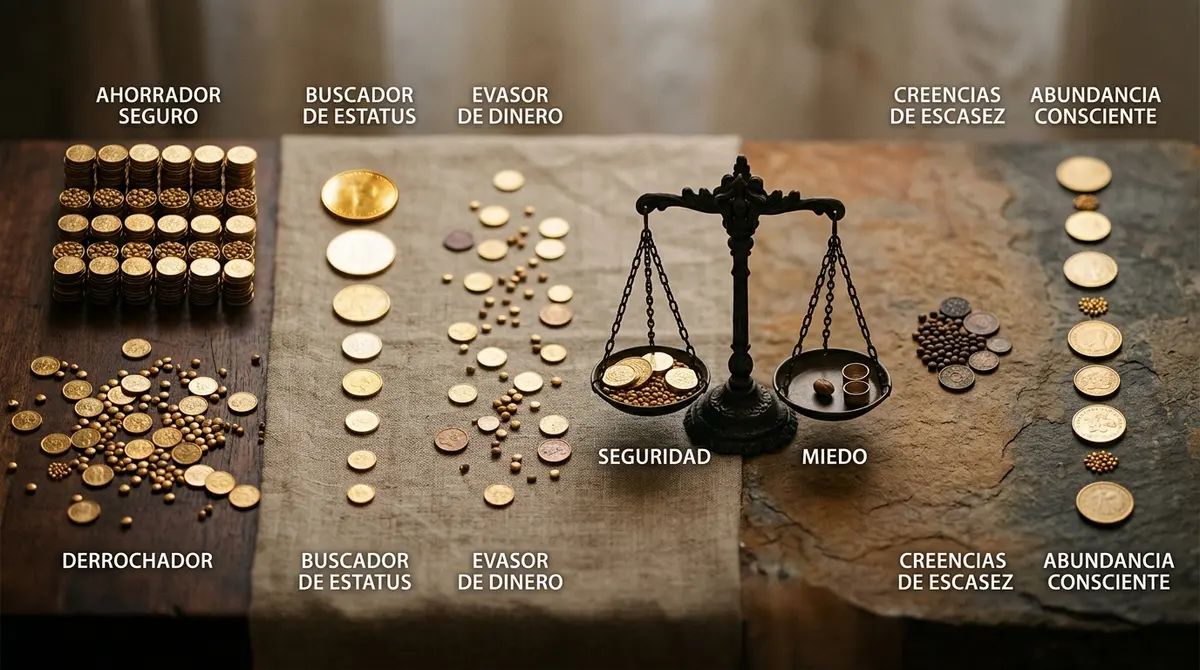
| Type | Distinguishing feature |
|---|---|
| Money avoidance | Typically forms in environments where money was associated with corruption, selfishness, or conflict ("rich people are bad people"). |
| Money worship | Develops when money was presented as the solution to all family problems. |
| Money status | Arises in environments where personal worth was measured by visible possessions. |
| Money vigilance | Common in families that went through real scarcity or economic instability. |
1. Money avoidance
Typically forms in environments where money was associated with corruption, selfishness, or conflict ("rich people are bad people"). It produces active avoidance of looking at one's own finances, guilt when receiving money, and unconscious financial self-sabotage.
2. Money worship
Develops when money was presented as the solution to all family problems. It produces the belief that "just a bit more" will always fix current distress, with no income level ever generating lasting satisfaction.
3. Money status
Arises in environments where personal worth was measured by visible possessions. It ties self-esteem directly to net worth or visible consumption, driving spending oriented toward social image rather than actual usefulness.
4. Money vigilance
Common in families that went through real scarcity or economic instability. It produces financial hypervigilance, difficulty enjoying spending even when sustainable, and persistent anxiety despite an objectively stable financial situation.
The main types of money mindset
The types of psychology of money and scarcity mindset are not financial personality boxes. They are emotional patterns that shape how you spend, save, ask, receive, negotiate, and plan. A person can be careful in one context and avoidant in another; generous with others and deprived with themselves; confident earning but ashamed receiving. The value of classification is to locate the pattern, not to turn it into identity.
Money mindsets often come from family scripts, economic history, cultural expectations, and repeated emotional scenes. A child may learn that money creates conflict, that asking is dangerous, that success creates distance, or that love is expressed through buying. Those lessons can remain active long after the adult situation changes.
Four money mindset patterns
| Type | How it shows up | Growth practice |
|---|---|---|
| Scarcity vigilance | Constant worry, fear of spending, difficulty enjoying resources. | Separate real planning from permanent danger signals. |
| Avoidant money style | Not checking balances, postponing bills, avoiding negotiation. | Open one number at a time and choose one next action. |
| Soothing through spending | Buying to regulate stress, loneliness, restriction, or shame. | Name the emotion before purchasing and offer another form of care. |
| Worth and visibility conflict | Fear of charging, guilt receiving, discomfort earning more. | Practice clear prices, direct requests, and receiving without apology. |
How to identify your dominant pattern
Look at repeated scenes rather than abstract beliefs. What happens when you need to check a balance, ask for payment, receive a gift, buy something pleasurable, discuss debt, or set a limit with family? Your first body response matters. Tightness, heat, avoidance, urgency, or shame often reveals the script before the mind explains it.
Then ask what the pattern protects. Scarcity vigilance may protect you from feeling unprepared. Avoidance may protect you from shame. Spending may protect you from deprivation or loneliness. Undercharging may protect you from rejection or visibility. When you understand the protection, the goal becomes updating the strategy rather than attacking yourself.
A practical money map
For one week, track one spending decision, one saving or planning decision, and one money conversation. Write the trigger, emotion, script, and adult action available. This turns money mindset into visible behavior. The aim is not perfect calm. It is shorter avoidance, clearer numbers, better boundaries, and more choice around receiving, spending, and asking.
Family context often reveals the type more clearly. If money was discussed through conflict, avoidance may feel safer than clarity. If sacrifice was praised, enjoyment may feel selfish. If success created envy or distance, earning more can activate guilt. If love was expressed mainly through buying, spending may become a way to create closeness. These scripts are not your fault, but they do become your responsibility once you can see them.
Relational patterns matter too. Some people lend money to avoid disappointing others, undercharge to remain liked, hide purchases to avoid judgment, or refuse help because receiving feels like losing power. Money is rarely only money in these moments. It is a language of belonging, control, autonomy, and care. Naming the relational layer often makes the practical step clearer.
Progress depends on matching the practice to the type. Scarcity vigilance needs grounded evidence and planned safety, not forced optimism. Avoidance needs gentle contact with numbers, not shame. Soothing through spending needs emotional alternatives before the purchase, not punishment afterward. Worth conflict needs direct receiving practice: saying a price, accepting praise, asking for payment, or letting support arrive without immediately repaying it with overgiving.
Most people are a combination of types. You may avoid checking numbers and then spend impulsively once stress becomes too high. You may save rigidly for yourself but become overgenerous with others to feel needed. You may charge confidently in professional contexts and still feel guilty receiving help from family. This is why a nuanced money mindset map is more useful than a single label.
Look for the sequence. What happens first: fear, avoidance, urgency, guilt, or shame? What action follows? What emotion appears afterward? A scarcity-vigilant person may feel relief after saving and then guilt for wanting anything pleasurable. An avoidant person may feel temporary relief after not checking an account, followed by more anxiety later. A soothing spender may feel comfort first and shame afterward. The sequence tells you where to intervene.
A practical intervention should be small and specific. For avoidance, schedule one five-minute money check. For scarcity vigilance, define what "enough safety for this week" actually means. For soothing through spending, create a non-purchase comfort list before the trigger. For worth conflict, rehearse one clear sentence about price, payment, or receiving. The point is not to become perfect with money; it is to make the automatic script less automatic.
Use the map as a living document. At the end of the week, ask which type appeared most often, which situation activated it, and what one adult action made the pattern less automatic. That is how a money mindset becomes changeable.
A healthier money mindset lets financial reality become information rather than identity. You can plan without panic, enjoy without denial, save without punishment, and speak about money without losing your self-worth.
- Each pattern forms in a distinct family context, not as a conscious adult choice.
- None of the four patterns corresponds directly to a person's actual income level.
- Most people combine traits of several patterns depending on life stage or specific financial area.
Discover your complete profile
If you want a personalized reading of the 12 dimensions + 3 annexes of your mind, start the self-knowledge test for free.
References and Bibliography
Selection of sources used as conceptual background for this article.
- Klontz, B., Britt, S. L., Archuleta, K. L., & Klontz, T. (2012). Disordered money behaviors. Journal of Financial Therapy, 3(1), 17-42.
- Furnham, A. (1984). Many sides of the coin: The psychology of money usage. Personality and Individual Differences, 5(5), 501-509.
- Tang, T. L. P. (1992). The meaning of money revisited. Journal of Organizational Behavior, 13(2), 197-202.