Personality Test vs Self-Knowledge Test: Methodological Differences
Although the terms are often used interchangeably, classifying personality and developing self-awareness are not the same thing. A traditional personality test may place you under a fixed descriptive label, while a self-discovery tool aims to help you identify and explore changing unconscious patterns. This article explains the key differences.
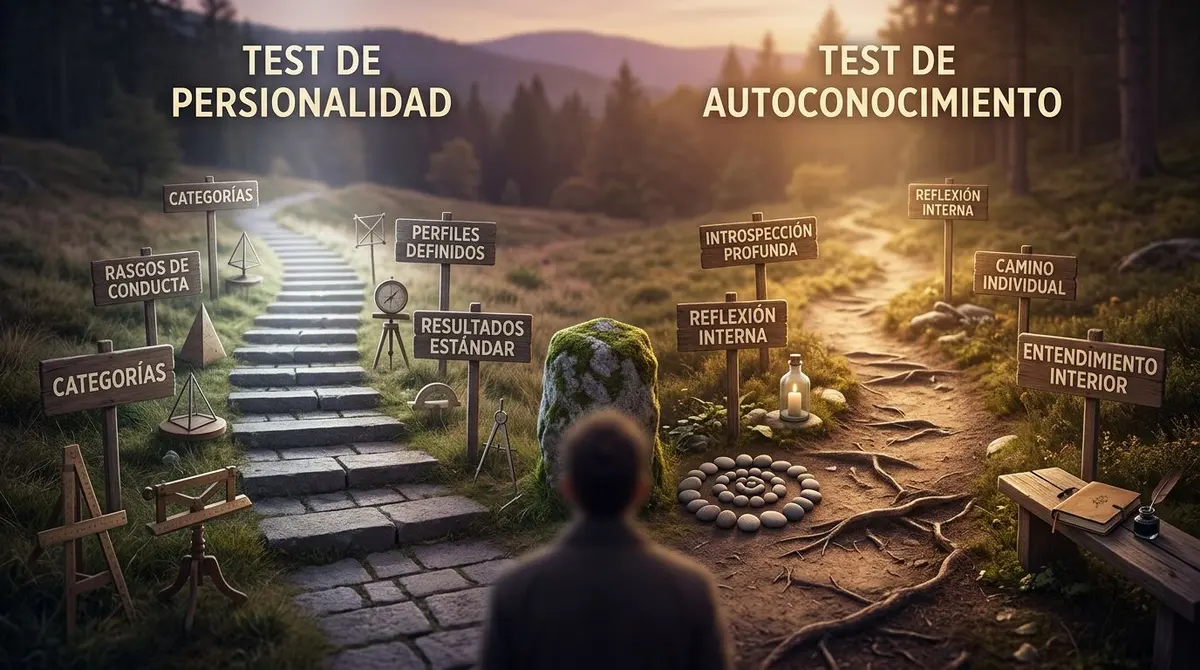
1. The Purpose: Classifying or Integrating?
Traditional personality tests (such as the MBTI, the Big Five, or the corporate DISC) were born with a descriptive focus for recruitment purposes. Their ultimate goal is classification: answering the question "How do I act?" and assigning you a box or label. This is useful in organizational contexts, but often ignores the fact that the human being is a plastic, constantly evolving system.
By contrast, a thoughtful self-discovery tool focuses on integration. Its central questions are not about which label fits you, but "Why do I act this way?" and "How are my physical responses connected to my emotional patterns?" Its purpose is to build awareness of unconscious defences so that you can respond with greater flexibility.
2. The Structure and Somatic Neurobiology
The vast majority of personality tests are purely cognitive and behavioral. They are based on self-reported questions about what you think of yourself, completely ignoring the autonomic nervous system and the body. Our structured methodology, on the other hand, integrates the body into the equation through the Polyvagal Theory, allowing the user to somatically map how their body reacts under stress before their conscious mind elaborates a story or defense mechanism.
Frequently Asked Questions (FAQ)
What is the psychological basis of this self-knowledge tool?
This tool is a reflective resource for personal pattern mapping. It is inspired by established psychological frameworks (Attachment Theory, Polyvagal nervous system states, ego defenses, and Jungian Shadow integration) across 15 dimensions of your personality.
How does this test differ from a formal psychological diagnosis?
This test is not a medical or diagnostic assessment. It does not diagnose mental disorders or replace psychotherapy. It functions as a structured self-reflection map for personal development.
Does the PRO report contain spiritual tools like Human Design?
Yes. To deliver a multi-dimensional perspective, the PRO report includes dedicated symbolic and energetic integration annexes (Human Design and Numerology), clearly demarcated and separate from the core modules.
How is the privacy and security of my personal data managed?
Your responses are processed completely anonymously and securely under SSL encryption. Your data is never sold, shared with third parties, or used for advertising, and is processed purely to generate your report.
The difference is classification versus integration
A personality test and a self-knowledge test can both be useful, but they answer different questions. A personality test usually describes relatively stable tendencies: how you behave, how you score compared with others, what traits or styles repeat across situations. A self-knowledge tool goes further into pattern meaning: why a response appears, what it protects, what state it comes from, and how it can become more flexible.
This distinction matters because labels can be comforting but incomplete. Knowing that you are introverted, high in conscientiousness, avoidant, assertive, or emotionally reactive may give language. But language alone does not change the moment when your body freezes, your defenses rise, your shadow projects, your attachment system panics, or your purpose gets avoided. Integration requires connecting the label to lived scenes.
A strong self-knowledge approach keeps the descriptive value of personality work while adding context: attachment, nervous system state, defense mechanisms, shadow material, relational patterns, money scripts, purpose, and repeated choices under stress.
Methodological comparison
| Dimension | Personality test | Self-knowledge test |
|---|---|---|
| Main question | What traits or styles describe me? | What patterns shape my reactions and choices? |
| Focus | Classification, comparison, stable tendencies. | Integration, context, emotional function, change. |
| Best use | Language for preferences and behavior. | Mapping triggers, defenses, needs, and next steps. |
| Risk | Turning a score into identity. | Overinterpreting without real-life evidence. |
When a personality test is useful
Personality tests are useful when you need a simple vocabulary for tendencies. They can help teams discuss working styles, help individuals notice preferences, and give structure to self-reflection. The Big Five, for example, can describe broad trait domains in a way that is more research-aligned than many popular typologies.
The limitation appears when a description becomes destiny. "I am just like this" can prevent learning. A trait may describe a tendency, but it does not explain every reaction or decide every future response. Human behavior changes with stress, safety, relationships, culture, health, grief, responsibility, and practice.
When self-knowledge goes deeper
Self-knowledge is useful when you want to understand the function of a pattern. For example, withdrawing may look like introversion, but in one person it comes from nervous system shutdown, in another from avoidant attachment, in another from a defense against shame, and in another from genuine need for solitude. The same behavior can have different roots.
This is why a richer methodology asks for scenes: what happened, what did your body do, what story appeared, what did you protect, what did you avoid, and what would a more integrated response look like? These questions turn self-description into changeable awareness.
After taking any assessment, choose one result and test it against daily life for a week. Notice where it appears, where it does not, and what conditions make it stronger. This keeps the result alive as inquiry instead of frozen as identity, and it makes the interpretation more accurate than a single score read in isolation.
The most responsible use of any test is not to let it name you completely. Use results as hypotheses. Compare them with behavior. Look for exceptions. Ask what becomes more flexible after you understand the pattern. A good tool should leave you with more choice, not a smaller identity.
- Traditional personality tests are static and seek to pigeonhole you into unchangeable labels.
- Structured self-knowledge tools are dynamic and focus on the "why" of your survival adaptations.
- Our methodology merges analytical psychology (Shadow) and somatic neurobiology into a single integrating experience.
Unlock your complete psychological profile
Understanding the foundational theory of Self-Knowledge is an outstanding milestone. To receive a highly detailed, 100% confidential reading mapping all 15 dimensions of your personality, we invite you to take our full self-knowledge test today.
References and Scientific Bibliography
- McCrae, R. R., & Costa, P. T. (2003). Personality in Adulthood: A Five-Factor Theory Perspective. New York: Guilford Press.
- Porges, S. W. (2017). The Pocket Guide to the Polyvagal Theory: The Transformative Power of Feeling Safe. New York: W. W. Norton & Company.
- Freud, A. (1936). The Ego and the Mechanisms of Defence. Vienna: Internationaler Psychoanalytischer Verlag.