Complete Guide to Internal Resources and Somatic Resilience: The Ultimate Self-Knowledge Map
Complete guide to resilience: the 4 internal resources that sustain it, how to identify yours, and real techniques to strengthen them.
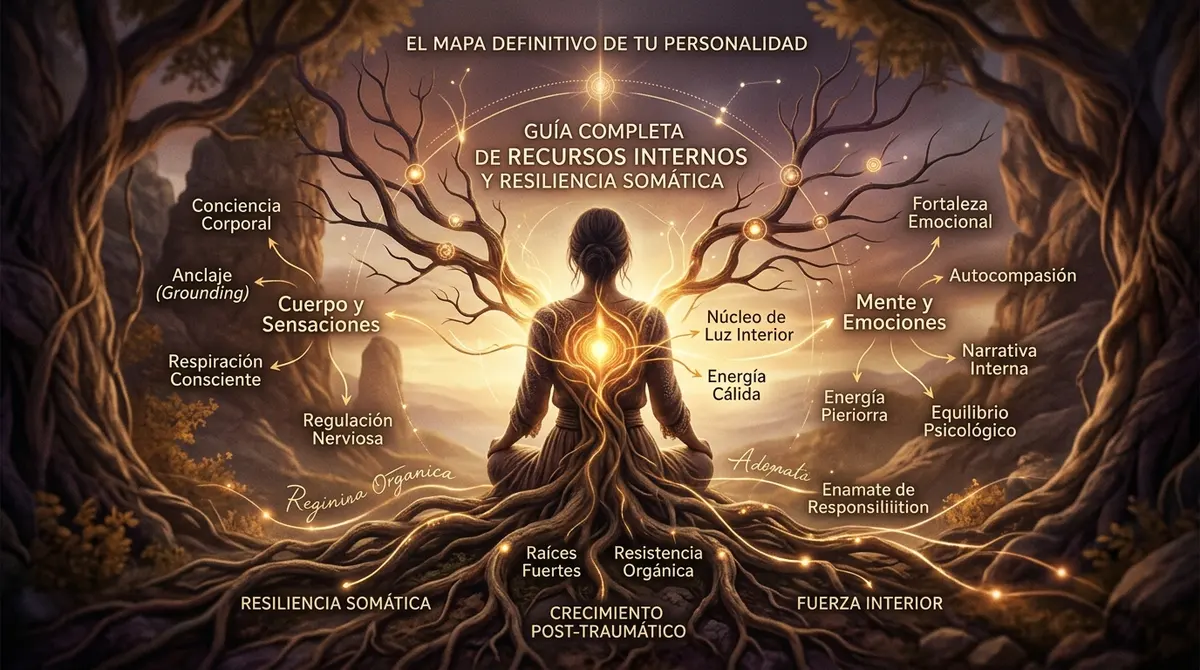
1. The 4 internal resources that sustain resilience
Resilience has been described as “ordinary magic”: positive outcomes emerging from common human adaptive systems rather than a rare, extraordinary trait (Masten, 2001). Commonly studied resources include emotional self-regulation, social support, cognitive flexibility, and sense of purpose, but they are not a universal checklist or a guarantee of outcomes.
2. How resilience shows up in practice
It isn't measured by the absence of reaction to adversity, but by the speed of recovery afterward: how long it takes the nervous system to return to calm, whether the person asks for help in time instead of toughing it out alone until exhaustion, and whether they can adapt the plan when reality doesn't match what was expected.
3. How each resource is strengthened
Change starts by mapping the resources already available (a real support list, your personal recovery track record, current sources of meaning) and then deliberately training each one: asking for help before the limit, practicing alternative interpretations in the face of difficulty, and a brief daily self-regulation practice during calm moments, not only in crisis.
Resilience is recovery plus adaptation
A strong resilience and coping guide does not describe resilience as never breaking down, never needing help, or staying calm in every difficult moment. Resilience is the ability to recover enough to keep adapting. It includes emotional reaction, confusion, grief, fear, anger, and fatigue. What matters is whether your system can return to a workable range, use support, update the plan, and keep some contact with meaning while reality is demanding more than usual.
This is why resilience should not be confused with endurance. Endurance can keep you functioning while the cost rises in the background. Resilience includes knowing when to stop, when to ask for help, when to change strategy, and when to stop calling overextension "strength." In daily self-knowledge, the key question is not "am I resilient?" but "which resources help me recover, and which coping strategies make the next day harder?"
The four resources that make coping sustainable
The first resource is emotional regulation: the capacity to feel without being completely ruled by the feeling. Regulation is not suppression. It may look like breathing before answering, naming what is happening, walking to discharge activation, or delaying a decision until your body is less flooded. The second resource is social support. Not every contact is supportive; the useful question is who helps you become more honest, more grounded, and more capable of action after speaking with them.
The third resource is cognitive flexibility. Under stress, the mind narrows and often presents one interpretation as the whole truth. Flexibility means asking for two or three alternative readings without forcing false optimism. The fourth resource is purpose: the thread that reminds you why a hard action is worth taking. Purpose does not need to be grand. It can be caring for your health, protecting a relationship, finishing a necessary transition, or acting in line with a value even when the outcome is uncertain.
| Resource | When it is weak | How to train it |
|---|---|---|
| Regulation | You react from urgency or shut down completely | Practice short body resets during calm moments, not only in crisis |
| Support | You isolate until the problem becomes heavier | Build a real list of people and define what kind of help each can offer |
| Flexibility | One catastrophic interpretation feels absolute | Write three plausible explanations and one small experiment |
| Purpose | Effort feels pointless or purely defensive | Connect the next action with a value, not with perfection |
Healthy coping versus coping that creates debt
Coping is anything you do to manage pressure. Some coping restores capacity; some only postpones the bill. Rest, honest conversation, planning, movement, prayer, therapy, and asking for help can all be restorative when they bring you closer to reality. Avoidance, compulsive scrolling, emotional eating, overworking, intellectualizing, people-pleasing, and controlling every detail can also reduce distress in the short term, but they often create emotional debt. The signal is what happens afterward: do you feel clearer and more able to choose, or more trapped and ashamed?
Instead of judging a coping strategy as good or bad in the abstract, look at its function. Does it give your nervous system enough safety to continue? Does it protect you from a feeling you are now ready to process? Does it preserve connection, or does it make you disappear from yourself? Mature resilience is not about removing every imperfect strategy overnight. It is about replacing one costly strategy at a time with something that meets the same need more cleanly.
A practical sign of real recovery is the return of proportion. The problem may still matter, but it no longer fills the entire room. You can answer one message, eat something simple, notice another person's perspective, or identify the next honest step. These small signs are easy to dismiss because they are not dramatic, yet they are often the first evidence that your coping strategy is restoring capacity instead of merely helping you endure.
A one-month resilience practice
Use the first week to observe your recovery time. After a difficult moment, how long does it take before you can think, speak, eat, rest, or decide with some steadiness? Use the second week to strengthen support: choose one person, one professional resource, or one community habit that reduces isolation. Use the third week for cognitive flexibility: when a stressful interpretation appears, write one compassionate version, one practical version, and one version you would offer a friend. Use the fourth week to connect action with purpose: choose one small behavior that protects a value you want to live, even if the situation is still unresolved.
This kind of practice turns resilience from an identity label into a trainable map. You begin to see which resources are naturally strong, which ones collapse first, and which coping strategies deserve replacement. The result is not a perfect version of you. It is a more prepared version: someone who can meet pressure with more honesty, recover with less shame, and choose help before exhaustion makes the choice for them.
- Resilience is a set of trainable resources, not a fixed trait you're born with.
- It's measured by speed of recovery, not by the absence of emotional reaction to adversity.
- Social support is, according to the available evidence, one of the strongest predictors of all the resources.
Discover your complete profile
If you want a personalized reading of the 12 dimensions + 3 annexes of your mind, start the self-knowledge test for free.
References and Bibliography
Selection of sources used as conceptual background for this article.
- Connor, K. M., & Davidson, J. R. (2003). Development of a new resilience scale: The Connor-Davidson Resilience Scale. Depression and Anxiety, 18(2), 76-82.
- Folkman, S., & Lazarus, R. S. (1984). Stress, appraisal, and coping. Springer.
- Luthar, S. S., Cicchetti, D., & Becker, B. (2000). The construct of resilience. Child Development, 71(3), 543-562.