Common Mistakes About Communication Styles and Radical Assertiveness: Myths You Should Debunk Today
Widespread false assumptions surround assertiveness and defensive communication. We debunk the most dangerous myths to help you map an honest, healthy, and respectful way of connecting.
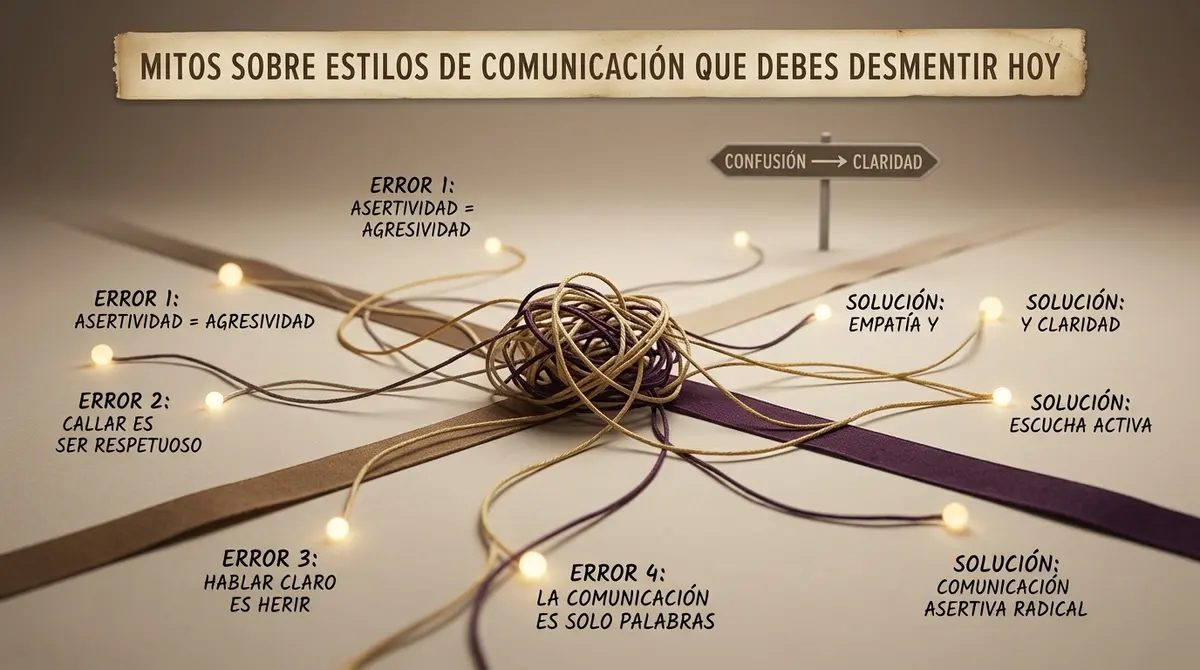
1. Theoretical Foundations and Scientific Evidence
The theory and practice of interpersonal communication are regularly hindered by cultural and familial misunderstandings of what constitutes a healthy expression of boundaries. Clinical and educational work on relationships suggests that myths—such as equating assertiveness with selfish rigidity or believing that passive silence prevents relational drift—can reinforce unhealthy patterns and dissatisfaction. Identifying and debunking these conceptual errors is useful for self-knowledge and relational maturity.
2. Psychological and Neurobiological Mechanisms
Myths and cognitive errors about communication act as rational justifications for learned defensive responses. Believing that "setting a boundary will drive my loved ones away" can keep a person in submission or people-pleasing. Conversely, justifying aggression under the guise of "brutal honesty" often hides fear of emotional vulnerability. Questioning these biases reduces the subjective perception of threat and supports clearer, firmer, more connected responses.
3. Integration and Transformation Tools
We propose three reflective exercises to actively deactivate communication myths: 1) The Relational Myth Analysis: write down your subconscious assumptions about conflict (e.g., "if I speak up, they will get angry") and contrast them objectively with real adult experiences, 2) Differentiating Honesty from Coercion: consciously practice separating the expression of your subjective truth while respecting the listener's dignity, from the reactive urge to impose your terms, and 3) The Resentment Log: document how defensive silence ("to avoid arguing") does not solve the underlying conflict, but accumulates internal anger and weakens the relationship over time.
The biggest communication mistakes look reasonable at first
Common mistakes about communication styles and radical assertiveness often survive because they sound mature on the surface. "I am just being honest" can hide aggression. "I do not want drama" can hide avoidance. "They should know what I mean" can hide fear of asking. "I am protecting the relationship" can hide resentment that is quietly accumulating. The mistake is not always in the intention; it is in the strategy.
Healthy communication does not mean saying everything immediately, never feeling defensive, or turning every emotion into a discussion. It means having enough clarity to know what belongs to you, enough courage to name what matters, and enough respect to avoid using truth as a weapon. Radical assertiveness is direct, but it is not careless. It protects self-respect and relational dignity at the same time.
Most communication myths come from earlier learning. If conflict used to mean rejection, you may equate silence with safety. If honesty was punished, you may overexplain before asking. If your needs were ignored, you may present requests as demands because softer forms once failed. Debunking myths is not an intellectual exercise; it is a way to update old relational expectations.
Myths that weaken communication
| Myth | Why it fails | Better principle |
|---|---|---|
| Assertiveness is selfish | It confuses having needs with disregarding others. | Clear needs make real negotiation possible. |
| Silence keeps peace | Unspoken resentment usually leaks into tone, distance, or withdrawal. | Timing matters, but avoidance is not repair. |
| Honesty excuses harshness | Truth without care often becomes control or discharge. | Say the truth in a form the relationship can use. |
| If they love me, they know | It turns mind-reading into a test of devotion. | Specific requests are kinder than hidden exams. |
How to catch a myth while it is happening
Choose a recent conversation that left a residue: tension, guilt, irritation, distance, or repeated mental replay. Ask which myth was active. Did you stay silent because you believed speaking would ruin everything? Did you push too hard because you believed being softer would make you invisible? Did you expect the other person to infer what you needed? Did you call something "boundaries" when it was actually punishment?
Then translate the myth into a cleaner sentence. Instead of "I should not have to ask," try "I want to practice asking directly." Instead of "I am just being honest," try "I want to be truthful without attacking." Instead of "It is fine," try "I am not ready to talk now, but I do want to come back to it." These replacements are small, but they change the emotional contract of the conversation.
Pay special attention to tone. Many communication mistakes are not in the content but in the delivery: a sigh before answering, sarcasm framed as humor, a long delay used to create insecurity, excessive explanation used to avoid a clear no. Mature communication includes the words, the timing, the body, and the repair after impact.
What better communication actually feels like
Better communication does not always feel comfortable. At first, it may feel exposed, especially if your old style protected you from rejection or shame. A direct request can feel rude even when it is respectful. A boundary can feel cruel even when it is necessary. A pause can feel like failure even when it prevents escalation. Discomfort alone is not evidence that you are doing it wrong.
The more reliable measure is what happens afterward. Do you understand each other more accurately? Is there less guessing? Can both people name a next step? Is repair possible if the conversation became tense? Does the same resentment need less repetition because something was finally stated clearly? These are better indicators than whether the conversation felt smooth.
One mistake worth watching is apologizing for impact while secretly keeping the same pattern. A real repair includes recognition, responsibility, and a changed next step. "Sorry you felt that way" usually protects the speaker. "I interrupted you, and next time I will pause before responding" gives the relationship something concrete to trust.
Another mistake is treating boundaries as announcements that require no conversation. Some boundaries are nonnegotiable, especially around safety or respect. But many everyday boundaries are relational agreements: availability, timing, privacy, emotional labor, money, family contact, or shared responsibilities. Naming the boundary clearly and listening to its impact helps it become structure rather than distance.
A useful weekly exercise is the resentment audit. Write one thing you are pretending is fine, one request you have not made, and one boundary you keep hoping someone will intuit. Choose the smallest of the three and communicate it with fact, feeling, need, and request. Over time, this practice prevents communication from becoming a storage room for unsaid truths.
- Radical assertiveness is not about winning arguments or imposing your point of view, but honoring your truth and needs respectfully.
- Honesty stripped of empathy and somatic regulation is not assertiveness; it is defensive aggression masquerading as frankness.
- Systematically avoiding healthy confrontation shifts direct relational conflict inside your own body, manifesting as somatic symptoms.
Discover your complete profile
If you want a personalized reading of the 12 dimensions + 3 annexes of your mind, start the self-knowledge test for free.
References and Bibliography
Selection of sources used as conceptual background for this article.
- Baldwin, M. W. (1992). Relational schemas and the processing of social information. Psychological Bulletin, 112(3), 461-484.
- Benjamin, L. S. (1974). Structural analysis of social behavior. Psychological Review, 81(5), 392-425.
- Gottman, J. M. (1994). What predicts divorce? Lawrence Erlbaum Associates.