Complete Guide to Nervous System Regulation (Polyvagal Theory): The Ultimate Self-Knowledge Map
Complete guide to using Polyvagal Theory as a self-observation map: connection, activation and shutdown states, orienting signs, and regulation techniques.
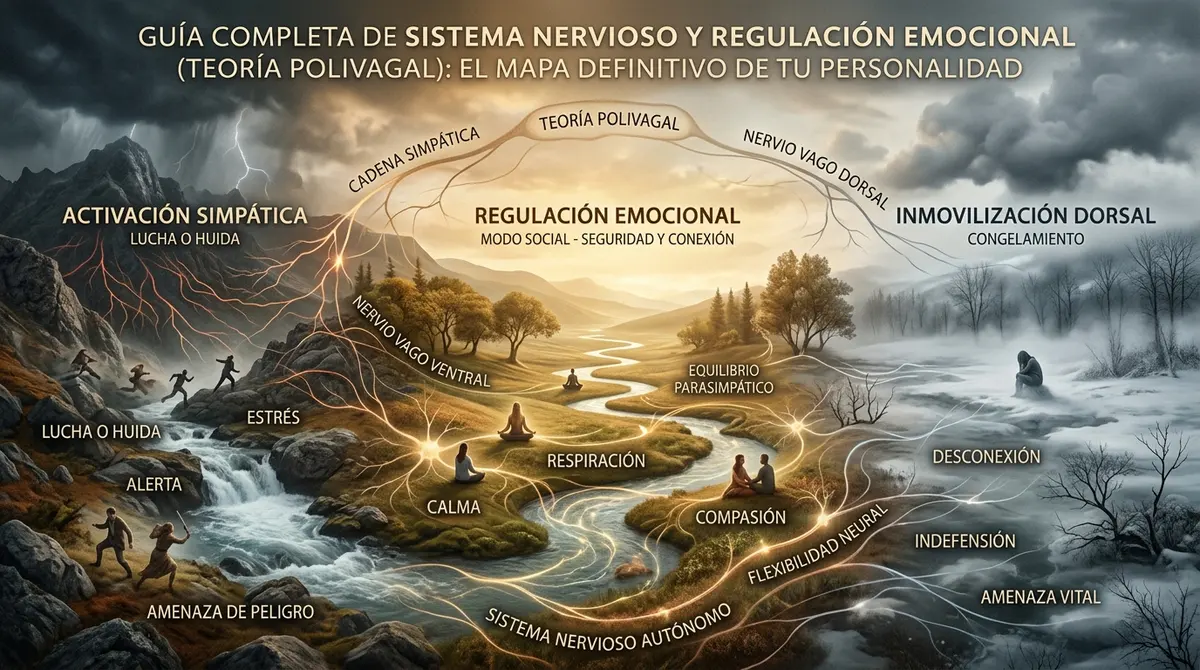
1. The three states per Polyvagal Theory
Developed by Stephen Porges, Polyvagal Theory proposes a map for understanding states of connection and safety, defensive mobilization, and shutdown or collapse. The term "neuroception" describes a fast, not always conscious evaluation of safety or threat cues. The theory is useful in clinical and somatic education, but some physiological claims remain debated; use it as orientation, not as a closed diagnosis.
2. How they show up day to day
Each state has orienting markers: wider breathing and natural vocal tone can accompany safety; racing pulse and urgency to act can accompany activation; a blank mind and disconnection can accompany shutdown. These are self-observation clues, not exact clinical measurements.
3. How regulation actually works
The goal isn't to stay calm at all times, but to recover flexibility after activation: extend the exhale, seek support from another person, use movement when you feel mobilized, or use gentle sensory grounding when you feel shut down. Treat the polyvagal labels as a self-observation map, not as direct measurement of vagal state.
A complete nervous system guide begins with state recognition
A complete guide to nervous system regulation is not a list of calming tricks. Regulation begins by identifying the state you are in before choosing a tool. A body in activation does not need the same support as a body in shutdown. A person inside connection can use language and reflection; a person in threat often needs safety signals before insight becomes available.
Polyvagal Theory offers a practical map of three broad states: social engagement and safety, defensive mobilization, and shutdown or collapse. The physiology behind the model is debated in some scientific details, so it is best used as an orientation tool rather than a diagnostic measurement. The value is in asking: what does my body believe is happening, and what signal would help it update?
This distinction prevents self-blame. Freezing in a conversation, reacting sharply, going blank, or needing distance may not mean you are immature or uncaring. It may mean your autonomic system has shifted into protection. The work is to notice the shift early enough to respond with care.
State-based regulation map
| State | Possible signs | Useful regulation direction |
|---|---|---|
| Connection | Breath, voice, curiosity, eye contact, flexible thinking. | Use conversation, reflection, planning, and repair. |
| Mobilization | Racing thoughts, urgency, anger, control, escape impulses. | Use movement, longer exhale, grounding, and timed pauses. |
| Shutdown | Blank mind, heaviness, numbness, silence, disconnection. | Use gentle orienting, warmth, small steps, and safe presence. |
How to choose the right tool
If you are mobilized, your body has energy available. Trying to force stillness can sometimes intensify the agitation. Walking, shaking out the arms, pushing gently against a wall, stretching, or lengthening the exhale can help the body complete enough of the activation cycle to regain choice. After that, language becomes more available.
If you are shut down, strong activation may feel like too much. The first step is usually tiny: noticing the room, feeling the feet, sipping water, holding a warm cup, naming one color, texting a safe person, or choosing one very small action. Shutdown often needs gentle re-entry, not pressure to perform regulation perfectly.
If you are in connection, use that state to prepare. Build routines, make repair agreements, clarify boundaries, and identify early warning signs. Many people only practice regulation during crisis, but the nervous system learns most reliably through repeated signals of safety when life is ordinary.
Common mistakes in nervous system work
The first mistake is treating calm as the only healthy state. Healthy regulation includes activation when action is needed and rest when recovery is needed. The goal is flexibility, not permanent serenity. A regulated person can become angry, move, protect, cry, speak, pause, and return.
The second mistake is using regulation to tolerate unsafe situations. If a relationship, workplace, or environment repeatedly violates safety, the solution is not simply better breathing. Regulation can help you think more clearly, but it may also help you leave, ask for support, set a boundary, or change conditions.
The third mistake is interpreting every body signal as absolute truth. Body signals are information, not final verdicts. A racing heart can mean danger, excitement, caffeine, lack of sleep, memory activation, or conflict anticipation. Good self-knowledge pairs body awareness with context, timing, history, and evidence.
A weekly regulation practice
For seven days, record one moment of activation and one moment of recovery. Write the trigger, body signs, behavior, tool used, and what helped most. This turns regulation from a vague aspiration into data. You may notice that some tools work only in certain states, or that co-regulation with a trusted person helps faster than solitary analysis.
Include context in the record. Sleep, food, caffeine, conflict, workload, loneliness, sensory overload, and hormonal or health factors can all change your capacity. Without context, people often blame themselves for dysregulation that was partly predictable. With context, patterns become visible: certain conversations need preparation, certain evenings need less stimulation, certain tasks require movement before focus.
It also helps to create a short regulation menu for each state. For mobilization: walk, shake, breathe out longer, reduce input, or take a timed pause. For shutdown: warmth, light, orienting, small movement, a simple message to someone safe, or one task with a clear endpoint. For connection: plan, repair, reflect, and strengthen routines. Having the menu ready prevents you from needing to invent wisdom while dysregulated.
Finally, remember that regulation is relational. A calm voice, predictable repair, respectful boundaries, and safe presence can regulate faster than private analysis. This does not make you dependent; it makes you human. A healthy nervous system learns both self-regulation and co-regulation.
Progress is measurable: you identify state earlier, recover faster, need less intensity to feel safe, and repair with less shame after dysregulation. That is the heart of nervous system regulation: not controlling every reaction, but widening the space between state, story, and response.
- The three states are hierarchical and automatic, assessed by the nervous system without passing through conscious thought.
- Each state has observable bodily markers (breathing, voice, presence) that let you identify it in real time.
- Effective regulation uses a different technique depending on the state — there's no single universal tool.
Discover your complete profile
If you want a personalized reading of the 12 dimensions + 3 annexes of your mind, start the self-knowledge test for free.
References and Bibliography
Selection of sources used as conceptual background for this article.