What is Psychology of Money and Scarcity Mindset: Definition, Background, and Key Ideas
Do you avoid checking your bank account for days, or, on the opposite end, do you obsessively track every expense even when you have no real financial problems? Research by Brad Klontz and colleagues on money scripts suggests that learned beliefs about money influence how we spend, save, avoid, or monitor it, beyond the exact amount available (Klontz et al., 2011).
Theoretical Foundations and Research
Brad Klontz and colleagues developed the concept of money scripts to describe beliefs about money — like «money corrupts» or «there's never going to be enough» — associated with problematic financial behaviors (Klontz et al., 2011). Adrian Furnham (1984) studied how the psychological meaning of money varies between people: for some it represents security, for others power, freedom, or even love. Thomas Tang (1992) developed a scale to measure this «money ethic» and explored how those associations relate to financial attitudes and anxiety.
This article is part of our personality cluster. For a comprehensive, unified view of this pattern, we highly recommend reading our Complete Guide to Psychology of Money and Scarcity Mindset.
Methodology for Somatic Integration
Changing your relationship with money requires identifying the script before trying to change the behavior. Three steps help:
- Identify your origin script: recall a specific phrase about money you heard repeatedly as a child, and notice how much it still drives your decisions today without you questioning it.
- Separate the real number from the feeling: before spending, saving, or avoiding a bank statement, tell apart whether you're responding to an objective figure or to an emotion inherited from that script.
- Practice the behavior opposite to your script, in small doses: if your pattern is avoidance, check your accounts once a week; if it's compulsive scarcity, allow yourself one conscious, planned purchase.
❓ Frequently Asked Questions
What is the psychology of money? ▼
It is the set of money scripts — learned beliefs about what money means and represents — that influence your financial behavior. They can form in childhood and keep operating even when your objective financial situation changes.
How does money mindset show up in daily life? ▼
It determines whether you avoid checking your finances, whether you spend to soothe an emotion, whether you save from security or from fear, and whether you feel financial anxiety disproportionate to your actual economic situation.
What money mindset really means
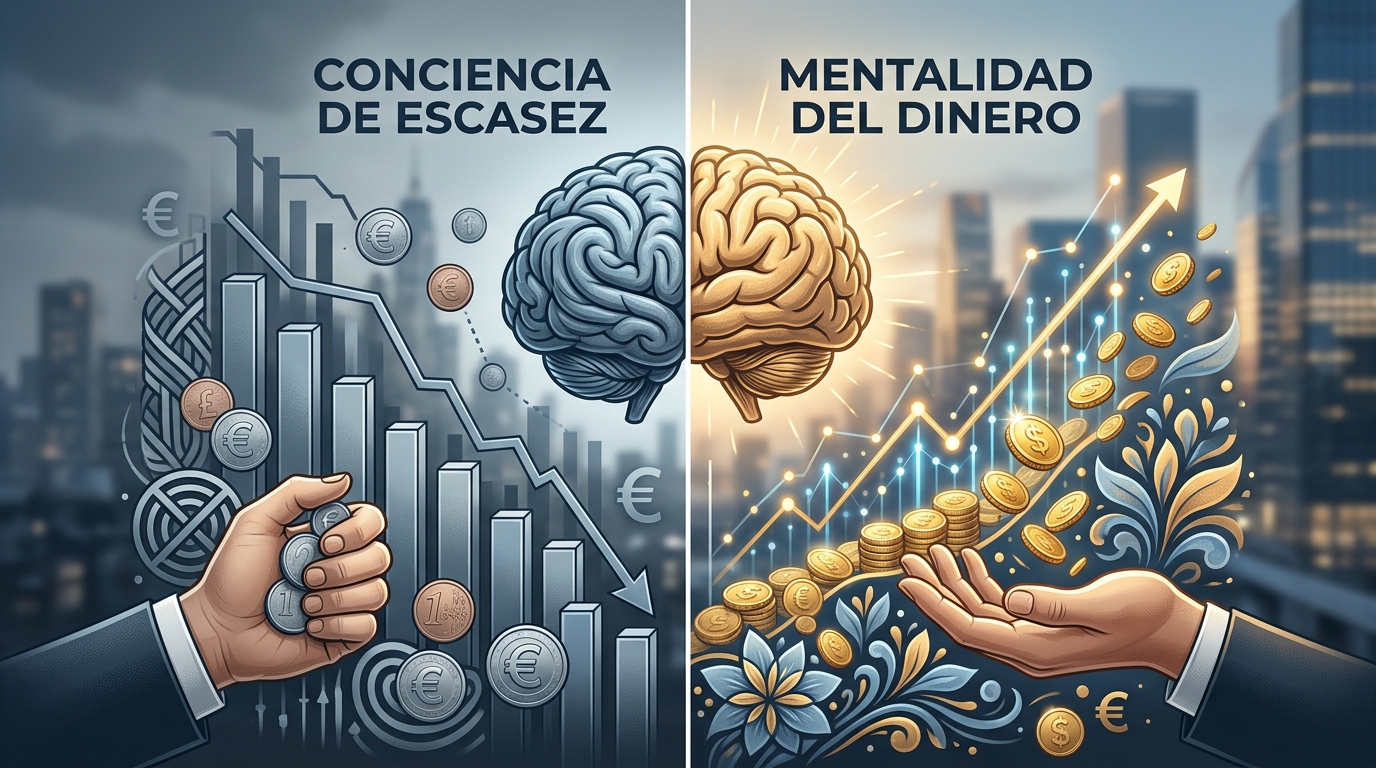
Psychology of money and scarcity mindset is not a fancy way of saying that someone is good or bad with finances. It describes the emotional meaning your nervous system gives to money before you have time to think rationally. For one person, money may represent freedom and possibility. For another, it may represent danger, conflict, shame, debt, family pressure, or the fear of losing love if they become too visible. The same paycheck, bill, price, savings account, or investment decision can therefore activate completely different inner responses.
This is why a money mindset test can be useful even when you already know the basics of budgeting. A budget shows what enters and leaves your account; your mindset shows what happens inside you when you look at those numbers. Do you avoid them until anxiety becomes unbearable? Do you spend as soon as you feel restricted? Do you save in a way that creates security, or in a way that keeps you permanently braced for disaster? Do you feel guilty receiving, asking, charging, negotiating, resting, or choosing a better option for yourself?
Scarcity mindset is especially subtle because it does not always look like having little money. Sometimes it appears as chronic urgency, as the belief that every opportunity must be grabbed before it disappears, or as the feeling that you are one mistake away from losing everything. In other cases it looks like emotional numbness: you stop checking, stop planning, stop opening messages, and hope the discomfort will pass by itself. Both patterns are protective attempts. One tries to control the future; the other tries to reduce present overwhelm.
Money scripts learned before adulthood
Most people do not invent their financial beliefs from scratch. They inherit them through repeated scenes: how adults spoke about bills, whether success was admired or criticized, whether asking for money created conflict, whether generosity was used as love, whether debt was hidden, whether saving meant wisdom, fear, or deprivation. These early money scripts become part of identity. Later, even when your real situation changes, the old emotional equation can keep running in the background.
For example, someone raised around constant financial tension may read a normal monthly expense as evidence that danger is near. Someone who learned that money created distance in the family may sabotage professional growth because visibility feels disloyal. Someone who saw love expressed through buying may struggle to distinguish generosity from self-abandonment. None of these reactions means the person is irrational. It means money has become linked with belonging, protection, status, control, or worth.
A daily practice that improves self-knowledge is to notice the sentence that appears before a financial decision. It may sound like: "I cannot afford anything," "If I say no, I am selfish," "If I earn more, people will expect more," "I have to fix this immediately," or "Looking at the numbers will make me feel worse." The exact wording matters. It reveals the rule your system is obeying.
Common signs of scarcity mindset in everyday life
Scarcity mindset is not only about spending too much or saving too little. It can show up in avoidance, overcontrol, comparison, secrecy, resentment, or the inability to enjoy something that is already paid for. The clearest sign is disproportion: the emotional charge is larger than the concrete situation in front of you. A small invoice feels like a threat to survival. A reasonable purchase feels like proof that you are irresponsible. A conversation about salary feels like exposure instead of negotiation.
| Signal | What it may be protecting | Healthier practice |
|---|---|---|
| Avoiding balances | Protection from shame, fear, or the feeling of being trapped. | Check one number at a fixed time, then write one next action. |
| Spending to soothe | A need for relief, comfort, autonomy, or celebration. | Pause for ten minutes and name the emotion before buying. |
| Rigid saving | A wish to feel safe after uncertainty or instability. | Create a small planned enjoyment category so safety includes life. |
| Fear of charging | Fear of rejection, visibility, or being seen as demanding. | Practice one clear price sentence without apology or overexplaining. |
How to work with your money mindset without shaming yourself
The goal is not to force "abundance thinking" on top of real financial stress. That kind of positivity can become another way of ignoring reality. A mature approach combines emotional honesty with practical contact. You acknowledge the fear, then you look at one concrete number. You notice the urge to avoid, then you take one small administrative step. You recognize an inherited belief, then you ask whether it still fits your current life.
Use three layers. First, identify the trigger: a bill, a price, a salary conversation, a tax email, a purchase, a loan, a family request, or a comparison on social media. Second, name the inner meaning: "I am unsafe," "I am behind," "I do not deserve this," "people will judge me," or "there will never be enough." Third, choose the next regulated action: opening the document, asking a question, setting a limit, postponing the purchase, making a transfer, or discussing expectations with someone involved.
This is where self-knowledge becomes practical. You are not trying to become a perfect financial machine. You are learning which situations activate scarcity, which needs are hidden underneath, and which habits create more stability. Over time, the relationship with money becomes less dramatic because it is no longer carrying every unresolved story about worth, safety, and belonging.
Questions that make the article useful
After reading, choose one recent financial scene and examine it slowly. What did you do first: check, hide, justify, ask, compare, buy, postpone, or control? What did your body feel before the decision? Which old rule seemed to be operating? Which adult resource did you forget you had? These questions are simple, but they prevent the article from becoming abstract SEO content. They turn it into a mirror for behavior.
For a full week, track only three moments: one spending decision, one saving or planning decision, and one conversation where money is present directly or indirectly. Write down the trigger, the emotion, the script, and the smallest responsible action available. By the end of the week, you will usually see whether your main pattern is avoidance, urgency, guilt, control, comparison, or fear of visibility. That is enough to begin changing the relationship without attacking yourself.
- Money scripts can form in childhood and are associated with adult financial behavior patterns, though they do not explain all economic behavior on their own.
- Money is rarely just money: each person attaches their own meaning to it — security, power, freedom, love — and that meaning drives their decisions.
- Changing financial behavior for good requires first identifying the unconscious script that sustains it.
Take the next step in your self-knowledge journey
Knowing the theory is excellent, but assessing your baseline will provide a highly personalized reading. We encourage you to take the free Psychology of Money and Scarcity Mindset test and receive your confidential report today.
References and Bibliography
Selection of sources used as conceptual background for this article.
- Klontz, B., Britt, S. L., Archuleta, K. L., & Klontz, T. (2012). Disordered money behaviors. Journal of Financial Therapy, 3(1), 17-42.
- Furnham, A. (1984). Many sides of the coin: The psychology of money usage. Personality and Individual Differences, 5(5), 501-509.
- Tang, T. L. P. (1992). The meaning of money revisited. Journal of Organizational Behavior, 13(2), 197-202.