5 Dangerous Myths About Relationship Patterns You Must Debunk Now
Pop psychology has handed us a set of tools that feel empowering on the surface — draw your circles of trust, build your walls, protect your energy, fix the toxic ones with enough love. Some of those tools are useful; others become rigid slogans. Concepts like "boundaries," "toxic relationships," and "circles of trust" need developmental precision: trust changes over time, boundaries are flexible filters rather than walls, and your body can be affected by relational stress without giving you a perfect diagnosis. This article dismantles five persistent myths about relationship patterns and circles of trust, grounding each rebuttal in developmental psychology, social network research, and trauma-informed caution.
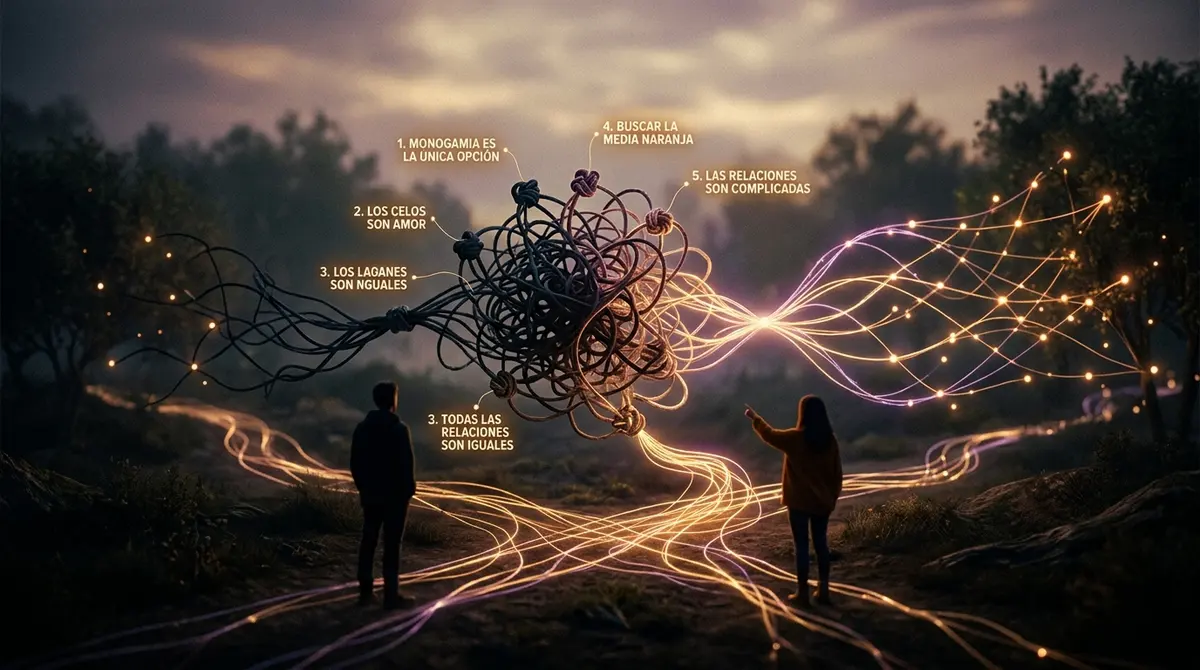
Myth 1: Circles of Trust Are Permanent, Static Maps You Draw Once
The Pop-Psychology Version
Countless worksheets and self-help videos invite you to draw concentric circles, assign each person in your life a fixed ring — inner circle, outer circle, acquaintance — and treat those placements as settled decisions. The underlying assumption is that you assign a slot, lock it in, and manage access to your emotional life accordingly. It sounds organized. It is also biologically inaccurate.
What the Science Actually Shows
Evolutionary anthropologist Robin Dunbar has described layered human social networks — roughly five core intimates, fifteen close friends, fifty broader friends, and one hundred and fifty meaningful contacts — shaped by closeness, contact frequency, and the time cost of maintaining ties (Dunbar, 2020). These tiers are approximate, not clinical rules. They are best used as a social map for reviewing emotional investment and reciprocity.
Developmental psychologist Ruthellen Josselson (Fielding Graduate Institute, 2008) deepened this picture through her concept of Relational Shapes — demonstrating that our internal maps of intimacy are constantly sculpted by unconscious relational scripts, real-time interactions, and early attachment wounds. A person you trusted implicitly five years ago may now occupy a different tier, not because of a conscious decision, but because the relational field between you has shifted organically.
Stephen Porges' Polyvagal Theory introduces the concept of neuroception: a proposed process by which the nervous system evaluates cues of safety or threat outside full conscious awareness. In relational work, this is useful language for noticing how your body responds to people and contexts. It should not be treated as proof that a person belongs in a particular circle, nor as a hardwired survival verdict beyond reflection.
Understanding what relationship patterns and circles of trust actually are at a neurobiological level is the necessary first step before any self-assessment tool can be used accurately.
Myth 2: Setting Healthy Boundaries Means Building Impenetrable Walls
The Pop-Psychology Version
"Cut them off." "If someone drains your energy, remove them immediately." "You owe no one access to your inner world." These phrases have become social media axioms, presented as the gold standard of self-protection. This framing equates boundary health with emotional fortress-building — the more impenetrable your wall, the healthier your psychology.
What the Science Actually Shows
Somatic psychologist Stanley Keleman, founder of Formative Psychology (1985/2000), offered a body-oriented language for noticing how emotional stress can appear in posture, tone, and muscular habits. His terms such as rigid shape and porous shape can be useful metaphors for self-observation, but they should not be treated as proof that stress creates fixed neural or muscular categories. Pop psychology can push people from porous straight into rigid, celebrating the transition as personal growth, even when both patterns remain dysregulated extremes.
Healthy boundaries are flexible: they can open for nourishing connection and tighten around genuine threat, without collapsing entirely or sealing shut permanently. Interoceptive awareness can help you notice when a yes is free, pressured, or resentful, but it is better framed as self-observation than as a real-time brain-region readout.
Furthermore, Porges' research on the Ventral Vagal Complex underscores that human beings are obligate co-regulators. We are biologically wired for connection. When we construct walls rather than semi-permeable membranes, we starve our nervous system of the co-regulation it requires for physiological homeostasis — paradoxically increasing allostatic load and systemic stress. Hyper-independence is not a boundary; it is insecure-avoidant attachment wearing the costume of self-sufficiency.
Myth 3: You Can Protect Your Emotional Field Through Cognitive Willpower
The Pop-Psychology Version
"Just don't let their energy affect you." "Visualize a protective bubble of light." "Choose not to absorb their negativity." This cluster of beliefs rests on the assumption that the mind can override the body's relational receptors through conscious intention or visualization. It sounds empowering. It describes a biological impossibility.
What the Science Actually Shows
In A General Theory of Love (2000), psychiatrists Thomas Lewis, Fari Amini, and Richard Lannon popularized the idea that human regulation is strongly relational. Their language of limbic resonance is useful as a metaphor for how presence, tone, and emotional cues can affect us, but it should not be treated as a direct measurement of mirror neuron systems, autonomic pathways, or another person's heart rate variability in everyday relationships.
This means that remaining in close physical proximity to a chronically hostile or dysregulated person and simply "choosing" not to be affected is often unrealistic. Your attention, stress level, and behavior may shift before you have fully named what is happening.
Practical emotional protection is not only a thought exercise. It can involve grounding, noticing body cues, reducing exposure, asking for support, and setting clearer limits. The goal is not to become immune to other people, but to recover orientation and choice when a relational field becomes stressful.
Myth 4: Enough Empathy and Patience Can Co-Regulate Anyone Back to Safety
The Pop-Psychology Version
"Hurt people hurt people" — and by extension, enough compassion, perfect communication, and unconditional positive regard can heal any toxic dynamic. This belief romanticizes co-regulation as an infinite resource and positions the empathic partner as the one responsible for healing the other person's relational wounds.
What the Science Actually Shows
Neurobiologist Bruce McEwen helped develop the concept of allostatic load: the cumulative biological burden of repeated or chronic stress. When a relationship is characterized by recurring betrayal, manipulation, unpredictability, or hostility, it can contribute to stress burden. Co-regulation is much harder when either person is actively defensive or afraid.
Research links chronic stress and low-quality relationships with poorer physical and mental health outcomes. It is too strong, however, to claim that a difficult relationship directly shrinks the hippocampus or causes measurable structural brain damage in a predictable way. The safer takeaway is that chronic relational threat is a real stressor and deserves practical protection.
Perhaps most importantly, attempting to empathize through chronic relational threat frequently produces a trauma bond — a neurochemical cycle of threat and intermittent reward heavily mediated by dopamine and oxytocin, creating an addictive attachment loop. In these scenarios, the only evidence-based developmental intervention is somatic containment, the establishment of physical safety, and in most cases, structured distance. Reframing the exit of a chronically toxic relationship as a vital biological intervention — not a failure of compassion — is one of the most deeply important perceptual shifts a therapist can facilitate.
For a practical developmental roadmap beyond these myths, the Complete Guide to Relationship Patterns and Circles of Trust provides the integrated framework connecting all dimensions of this work.
Myth 5: Your Relationship Patterns Are Fixed Personality Traits You Cannot Change
The Pop-Psychology Version
This final myth sits at the opposite end of the spectrum from the previous one — rather than over-investing in changing others, it assumes that you yourself are locked into your patterns. "I'm just an anxiously attached person." "I've always been avoidant — that's just who I am." "My relationship patterns come from childhood and there's nothing I can do about them." This belief produces paralysis and resignation.
What the Science Actually Shows
Developmental neuroscience uses the concept of experience-dependent neuroplasticity to describe how the brain can keep adapting in response to experience, including relational experience, even in adulthood. Early attachment patterns (Bowlby, Ainsworth) can influence adult relational schemas, but they should not be presented as fixed neural pathways or deterministic sentences. They are better understood as learned defaults that can shift with repeated experience and support.
Research on earned security — associated with Mary Main and subsequent attachment-informed writers — suggests that some individuals with insecure early attachment histories can develop more secure adult patterns through corrective relational experiences, reflective functioning, and supportive work. It is safer to describe this as relational learning and plasticity rather than guaranteed brain rewiring.
This is why many people benefit from approaches that include body awareness, trauma processing, parts work, and relational repair, not only cognitive insight. The patterns you carry are not your identity; they are learned adaptations to relational environments. With appropriate tools and support, those adaptations can evolve. You can explore specific approaches in our companion article on somatic tools for improving relationship patterns.
This also underscores the value of precise self-assessment grounded in our self-knowledge assessment methodology: before you can change a pattern, you must see it clearly — with careful psychological analysis, not pop-psychology shorthand.
The Developmental Paradigm Shift: From Cognitive Control to Somatic Awareness
| Pop-Psychology Myth | Developmental Neurobiological Reality | Evidence-Based Approach |
|---|---|---|
| Static circles of trust | Dynamic, neuroception-governed tiers | Polyvagal-informed relational therapy |
| Walls as boundaries | Semi-permeable somatic membranes | Formative Psychology (Keleman) |
| Cognitive energy shields | Open-loop limbic resonance systems | Somatic Experiencing (Levine) |
| Infinite empathy fixes toxicity | Chronic stress causes structural brain damage | Allostatic protection and containment |
| Patterns are fixed traits | Experience-dependent neuroplasticity | IFS, EMDR, earned secure attachment |
Trust is not a diagram you draw. It is not a wall you build or a shield you activate. It is a biological state your nervous system inhabits — one that can be assessed, understood, and deliberately cultivated through somatic awareness, neurobiologically-informed relational practice, and honest self-knowledge. The first step is seeing your own patterns with careful psychological analysis. If you want to know where exactly your relational patterns currently stand, take the free Relationships Test and receive a data-grounded picture of your circles of trust today.
❓ Frequently Asked Questions
Why is treating circles of trust as static harmful to my relationships? ▼
Static trust maps ignore the practical reality that relationships change over time. Rigidly locking people into fixed tiers can cause you to misread normal shifts in intimacy as betrayal rather than as relational evolution.
What is the developmental difference between a boundary and an emotional wall? ▼
A boundary is a semi-permeable somatic membrane with motility — it expands to allow nourishing connection and contracts to filter genuine threat while you remain relationally engaged. An emotional wall is a rigid, overbound somatic shape that blocks co-regulation entirely, increasing allostatic load and mimicking insecure-avoidant attachment patterns.
Can you actually protect your emotional field from someone else's dysregulation? ▼
Not through cognitive willpower alone. Being near a highly distressed or hostile person can affect your own stress level, attention, and body state. Genuine protection comes through grounding, boundaries, support, and changing proximity when needed.
Is it always wrong to stay in a difficult relationship and try to help the other person? ▼
Not always, but context is critical. Brief relational stress is part of healthy intimacy. Chronic relational threat — recurring betrayal, manipulation, hostility, or fear — is associated with stress burden and poorer health outcomes. When threat is constant, distance can be reasonable protection, not a moral failure.
Can relationship patterns established in childhood really be changed in adulthood? ▼
Yes. Experience-dependent neuroplasticity allows the brain to reorganize relational architecture throughout the lifespan. Research on 'earned security' (Main, Siegel) shows that individuals with insecure early attachment can achieve secure adult relational functioning through corrective relational experiences and evidence-based somatic therapies such as EMDR, IFS, and Somatic Experiencing.
- Circles of trust are fluid: Robin Dunbar's research supports approximate relational tiers, but they should be updated through reciprocity, contact, trust, and lived behavior.
- Walls are not boundaries: Somatic psychology distinguishes between healthy semi-permeable membranes (motile, pulsating) and rigid overbound shapes that cut off co-regulation and increase allostatic stress.
- You cannot cognitively block limbic resonance: Mammalian brains are open-loop systems; proximity to a dysregulated person produces automatic autonomic attunement regardless of mental effort.
- Chronic relational threat is a serious stressor: Prolonged exposure to harmful relationship dynamics is linked with poorer physical and mental health outcomes, but it should not be presented as predictable structural brain damage in every person.
- Relationship patterns can change: Earned security research and integrative therapy models suggest that adult attachment and relational habits can shift with repeated corrective experiences.
- The developmental shift is from rigid control to flexible awareness: Real relational health is built through honest self-assessment, body awareness, boundaries, and repair.
The myths dissected in this article are not harmless oversimplifications: they shape how people manage consequential relationships, often deepening the very patterns they are trying to heal. Moving from pop-psychology slogans to careful self-knowledge is not an academic exercise; it is a practical developmental step. When you understand how trust, boundaries, stress, and repair interact, you gain a more actionable map of your relational world. For a deeper, personalized analysis with specific strengths and growth areas, consider accessing your the PRO report as a secondary option after completing the free test after your assessment. If you want to know your current baseline level of Relationship Patterns and Circles of Trust and receive a personalized, confidential analysis, we invite you to take the complete Relationships test today.
References and Scientific Bibliography
- Baldwin, M. W. (1992). Relational schemas and the processing of social information. Psychological Bulletin, 112(3), 461.
- Benjamin, L. S. (1974). Structural analysis of social behavior. Psychological Review, 81(5), 392.
- Gottman, J. M. (1994). What predicts divorce? The relationship between marital processes and marital outcomes. Lawrence Erlbaum Associates.