The Types of Relationship Patterns and Circles of Trust: Complete Classification and Characteristics
Understanding Relationship Patterns and Circles of Trust is, at its core, a relational exercise: Structure of concentric circles of intimacy, setting healthy boundaries, emotional field protection, and managing toxic connections. This article approaches it from that angle, so you can recognize the pattern in your own life before trying to change it.
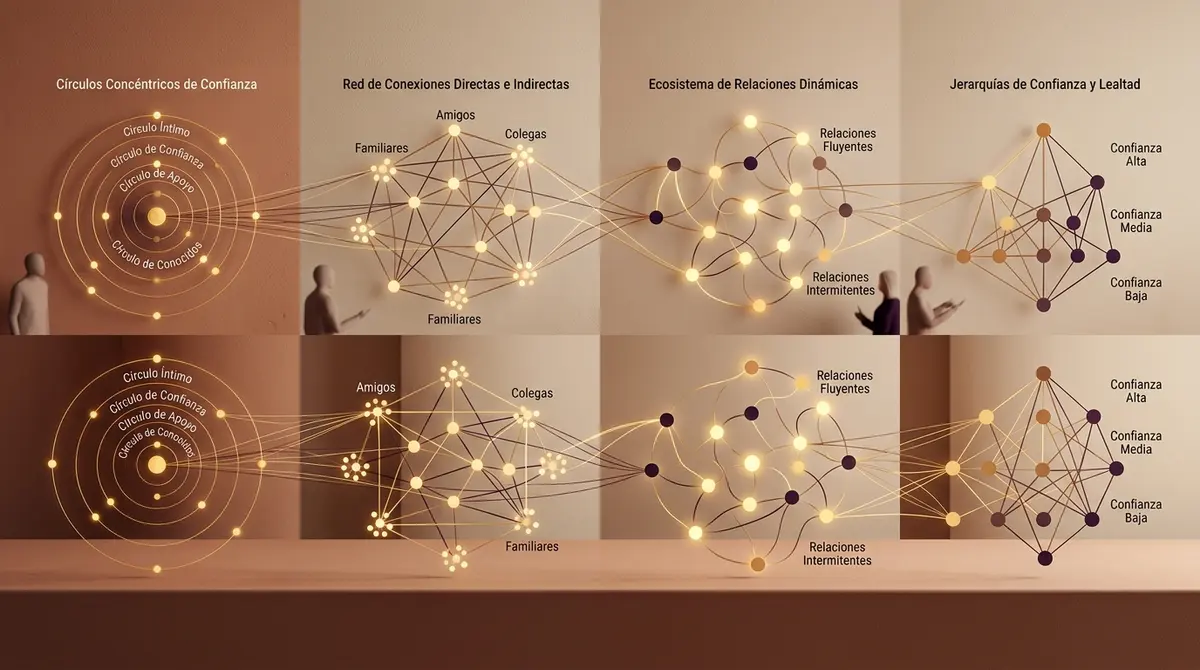
| Type | Distinguishing feature |
|---|---|
| Theoretical Foundations and Research | The dimension of Relationship Patterns and Circles of Trust is widely studied in contemporary psychology. |
| How this pattern shows up in your relationships | This pattern doesn't live in the abstract: it activates in how you move toward, pull away from, or negotiate closeness with other people. |
Theoretical Foundations and Research
The dimension of Relationship Patterns and Circles of Trust is widely studied in contemporary psychology. Research suggests that this pattern solidifies during early experiences and constructs the filter through which we interpret the world, our relationships, and our sense of internal safety.
This article is part of our personality cluster. For a comprehensive, unified view of this pattern, we highly recommend reading our Complete Guide to Relationship Patterns and Circles of Trust.
How this pattern shows up in your relationships
This pattern doesn't live in the abstract: it activates in how you move toward, pull away from, or negotiate closeness with other people. Working with it maturely comes down to three concrete fronts:
- Watch the bond in real time: Notice what your body and attention do the moment someone moves closer or further away.
- Name the pattern out loud: Put words to the dynamic with the other person present, not just inside your own head.
- Practice small boundaries: Rehearse a clear ask or a clear no in low-stakes situations before the high-stakes ones.
❓ Frequently Asked Questions
What is Relationship Patterns and Circles of Trust? ▼
It is a useful lens for structured self-reflection. Exploring it can help you notice recurring patterns and consider different responses.
How does Relationship Patterns and Circles of Trust influence daily life? ▼
It manifests continuously in our personal relationships, our response to workplace stress, and how we bodily process safety or threat.
- This pattern was learned in real relationships, so it also changes inside real relationships.
- Learn to tell apart the automatic relational reaction from the actual choice you have today as an adult.
- A serious relationship doesn't require you to stop feeling this; it requires you to learn to name it with the other person.
Take the next step in your self-knowledge journey
Knowing the theory is excellent, but assessing your baseline will provide a highly personalized reading. We encourage you to take the free Relationship Patterns and Circles of Trust test and receive your confidential report today.
References and Bibliography
Selection of sources used as conceptual background for this article.
- Baldwin, M. W. (1992). Relational schemas and the processing of social information. Psychological Bulletin, 112(3), 461-484.
- Benjamin, L. S. (1974). Structural analysis of social behavior. Psychological Review, 81(5), 392-425.
- Gottman, J. M. (1994). What predicts divorce? Lawrence Erlbaum Associates.