What is Carl Jung and Shadow Work Integration: Definition, Background, and Key Ideas
Why do certain people irritate you in a way that's disproportionate to what the situation would actually justify? Carl Jung called this shadow projection: the traits you reject most in others are often precisely the ones your own mind has exiled from your conscious identity, and now recognizes — with rejection — in the mirror of another person.
Theoretical Foundations and Research
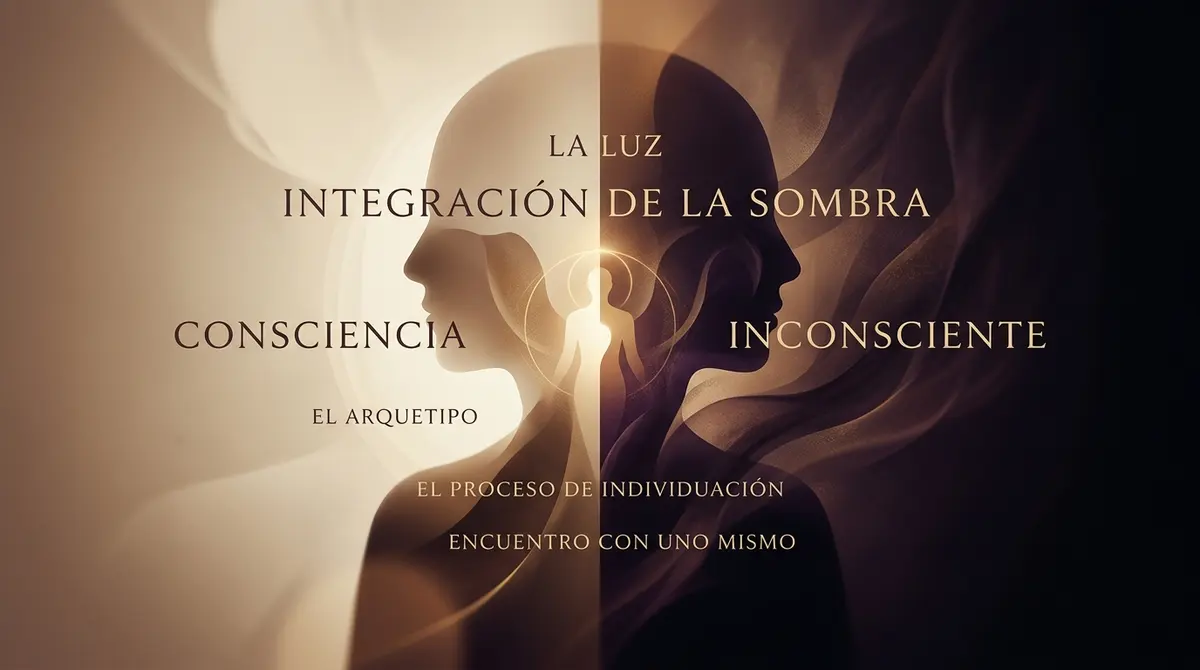
Carl Jung (1959) defined the shadow as the set of traits, impulses, and desires the conscious self considers unacceptable and therefore represses into the unconscious — without this eliminating them, it simply stops recognizing them as its own. Connie Zweig and Jeremiah Abrams (1991) popularized the idea that shadow material can be projected onto other people, so intense, disproportionate irritation may sometimes point to an unacknowledged trait in yourself rather than only an objective flaw in the other person. Robert Johnson (1991) added that the shadow isn't only negative: it can also hold talents, desires, and positive potential that a person repressed for not fitting the acceptable self-image they learned to present.
This article is part of our personality cluster. For a comprehensive, unified view of this pattern, we highly recommend reading our Complete Guide to Carl Jung and Shadow Work Integration.
Methodology for Somatic Integration
Integrating the shadow doesn't require eliminating it — it requires recognizing it as a legitimate part of your own psyche. Three steps help:
- Track disproportionate irritation: identify the person who triggers an intense rejection in you and ask yourself honestly what trait of theirs you might be denying in yourself.
- Check your golden shadow too: notice who you admire disproportionately, since that often points to a talent of your own you don't yet allow yourself to express.
- Practice owning the trait: instead of judging the trait you're projecting onto the other person, explore what it would feel like to recognize it, with nuance, as a possibility present in you too.
❓ Frequently Asked Questions
What is the shadow according to Carl Jung? ▼
It's the set of traits, impulses, and desires the conscious self finds unacceptable and represses into the unconscious without actually eliminating them, so they keep influencing behavior and often get projected onto other people as disproportionate rejection or admiration.
How does the shadow show up in daily life? ▼
It shows up as intense irritation toward specific traits in other people, as disproportionate admiration for those who express a talent you yourself repress, and as impulsive behavior that contradicts the conscious image you hold of yourself.
Shadow work is the practice of reclaiming what the ego rejects
Shadow work is not about becoming darker, more dramatic, or fascinated with every impulse. In Jungian language, the shadow contains traits, desires, emotions, capacities, and needs that the conscious identity has not been able to include. Some were rejected because they were judged as wrong. Others were hidden because they were too powerful, too sensitive, too ambitious, too creative, or too visible for the environment where you learned to belong.
The shadow becomes visible through projection. A trait you cannot recognize in yourself may appear exaggerated in another person. You may feel disproportionate irritation toward someone's confidence, neediness, anger, sensuality, ambition, laziness, sensitivity, or desire for attention. The other person may genuinely have that trait, but the intensity of your reaction can reveal that the trait also carries personal meaning for you.
Shadow work begins when you stop asking only "what is wrong with them?" and add "what does my reaction show me about what I reject, fear, envy, or forbid in myself?" That question does not excuse harmful behavior in others. It simply prevents your inner material from being hidden behind judgment.
Where the shadow tends to appear
| Signal | What it may reveal | Integration question |
|---|---|---|
| Intense irritation | A trait you condemn or fear in yourself. | What healthy form of this trait do I need? |
| Disproportionate admiration | A golden shadow: potential you have not claimed. | How can I practice 5% of that quality? |
| Recurring shame | A need or impulse that was made unacceptable. | What would compassionate ownership look like? |
| Out-of-character behavior | A rejected part acting without conscious language. | What was this part trying to protect or express? |
Projection is information, not proof
A mature approach to shadow work avoids two mistakes. The first is assuming every criticism is projection. Sometimes your irritation is accurate: a boundary has been crossed, a value has been violated, or someone is behaving harmfully. The second mistake is assuming projection means the other person has done nothing wrong. Shadow work is not self-blame. It is a way to examine the extra emotional charge around a situation.
Use a three-part check. First, name the external fact: what actually happened? Second, name your reaction: how intense was it, and what did it make you want to do? Third, ask what the trait represents in your inner world. If someone's ambition irritates you, maybe you value humility; maybe they are genuinely inconsiderate; or maybe your own ambition was punished and now appears as judgment. The quality of the work is in holding all possibilities long enough to learn.
The golden shadow is often gentler but just as important. When you admire someone with an ache, pay attention. Their courage, beauty, discipline, freedom, softness, intelligence, leadership, or creativity may point to a capacity you have exiled. Integration does not mean copying them. It means practicing a small, honest version of that quality in your own life.
How to practice shadow integration safely
Start small. Choose one recurring reaction and write the sentence: "A part of me rejects this because..." Then complete it several times. You might find fear of being judged, fear of losing control, loyalty to family rules, old shame, or grief for a self you never got to develop. The goal is not to act out the shadow; it is to give language to what has been operating without language.
Integration needs boundaries. Owning anger does not mean attacking. Owning desire does not mean violating commitment. Owning ambition does not mean contempt for others. Owning sensitivity does not mean making every feeling someone else's responsibility. A shadow trait becomes usable when it is joined with awareness, ethics, and choice.
You can measure progress by emotional charge. The person who used to trigger obsessive judgment may become simply informative. The quality you admired may become something you practice. The shameful impulse may become a need you can name responsibly. That is shadow integration: less projection, more ownership, and a wider self.
- Disproportionate irritation toward another person often points to an unacknowledged trait in yourself, more than to an objective flaw in them.
- The shadow isn't only negative: it also holds talents and desires of your own that were repressed for not fitting your acceptable self-image.
- Integrating the shadow doesn't mean acting on every repressed impulse — it means recognizing it as a legitimate part of your own psyche instead of projecting it onto others.
Additionally, much of what we repress in our shadow manifests in our interpersonal relationships. For instance, control impulses or excessive fear of rejection often hide in the unconscious, affecting how we connect. If you want to understand how your inner defenses interact with your relationship patterns, we recommend complementing this analysis by taking our free attachment style test online.
Take the next step in your self-knowledge journey
Knowing the theory is excellent, but assessing your baseline will provide a highly personalized reading. We encourage you to take the free Carl Jung and Shadow Work Integration test and receive your confidential report today.
References and Bibliography
Selection of sources used as conceptual background for this article.